Wednesday, 6 June 2018

INTIMATE PARTNER VIOLENCE: THE ABUSERS AND THE KIND OF VICTIMS THEY SEEK.


The problem with domestic violence is real.
Gender socialization continues to play a major role in this matter. Men are trained to be strong and never to show emotion, they are also never to cry. However, women are socialized to be meek, demure, to be in the kitchen, to be emotional and to be compassionate. This kind of upbringing gradually morphs into a narrative where when men advance in years and lose control in other areas of their lives like their education or their finances, they take the frustrations out in a different manner than women normally would. If something does not go right, they want to regain that power and control in some other aspect of their lives, albeit in a disastrous approach.
They take out their frustrations on the people closest to them. The desire and need for control is so strong, most men simply have to have at least one area of their lives where they are in control when they are physically present in that chosen environment and especially when they are not. When men are socialized to always block out their weaknesses, the easiest thing to put out there is anger and disrespect toward those who can. I do not seek to criminalize men. Women can be abusers too, in even more creative ways.

Many people, who have never been victims themselves, never understand why victims stay.
Many of these victims say this unhealthy loyalty stems from various reasons ranging from the fear of losing their children to financial instability if they set out to be alone.

Abusers come in all shapes in sizes. They usually appear like the nicest people. It is always so easy to be carried away. It takes a high level of discernment to be able to recognize a potential abuser when one sees one. What abusers really first look for in their victims is lack of self￾assuredness. They stay well away from confident, well-informed, powerful and strong women. If you are a woman who knows what she wants, abusers do not want to be anywhere near you because it is hard work to manipulate or pummel you into submission or fear of their presence.

Their victims are women who usually always try to keep peace; women always make excuses for their abusers because they are naturally trusting and forgiving. These women believe they can change their abusers with their love and support.
Because the abusers continue to feel a sense of power or control, they never really change.
When they are depressed, their women are on the receiving end. Victims deflect onlookers who try to help them get out of such relationships from the negatives and focus on the positives. They
usually remain very hopeful until they see they are really on a rollercoaster.

What parents need to do, instead of telling their children when to cry or when not to, is to raise strong, confident, self-assured children who truly know themselves and know the kind of energy they send off into the world.

HUMAN TRAFFICKING: THE NIGERIAN PERSPECTIVE.

Trafficking is essentially a trade in humans. It is estimated that the human trafficking business earns $150 billion annually, through illicit profits, while NGOs (Non Governmental Organizations) and governments spend an estimated $130 million annually to combat this crime. There is no indigenous data of the people trafficked within and outside Nigeria, except from foreign researches and the United Nations. It is estimated that each year, more than 500,000 young women from Nigeria illegally cross to Europe to become prostitutes. How do these women end up in Europe?

These victims who are desperate to escape the poverty they live in, are trafficked and exploited by men and women of their own nationality, and once they get into Europe, they are sold into the sex trade. They are promised jobs as cleaners, farmers, nannies, cooks, etc. However, there are usually no cleaning or cooking jobs waiting for them and they are forced into prostitution. They are threatened and taken to witch doctors where they drop parts of their bodies as collateral, to secure their loyalty to their “agents”. The women are made to drop hair from their heads and private parts, their fingernails and toenails, their clothing too. Sometimes they are also given incision marks on their chests and heads, and then made to take oaths not to mention it to anyone or they would die. Some escape. Some never do.

Everywhere in the world, the consequences of human trafficking are devastating. Women who eventually make it out of the trade may be permanently traumatized and continue to feel a sense of loss and regret. Many who return home may become huge burdens on their families. Some may be re-trafficked. Victims return to their families with severe health and psychological problems that their families simply cannot afford to treat. They also suffer stigmatization. Some women who used to be victims of the sex trade have shared their stories with researchers. It is however common to see that they never truly recover from the nightmare.

“Someone came up to me and asked me if I wanted to go to Europe, he said I would be farming where they produce tomatoes. At the end of the day, I was sold into prostitution. I donated my hair, nails and clothing to a juju priest and vowed to pay for the help rendered to me or I would die. I wanted to run away but I could not because he had a lot of friends hanging around watching me. I lived in a room with 20 girls who were all sex workers. For five years, I was always very tired and very lonely. You cannot send money to your family and you cannot eat very well. When I finally paid my $40,000 debt, I was arrested and jailed for five months. Anytime I remember, I start crying and lose my appetite. I feel bad. I have no interest in trying to turn them in. They will be punished.”
Patience, formerly trafficked lady, Italy (In Focus, 3, December, 2012, Nigeria Sex Trafficking)

“All my life is sleeping, sleeping, sleeping with men. I know they will come looking for me. If I see my captors again, I’m not going to say nothing. I’m just going to kill them. That’s what I’m going to do. Because she ruined my life. Made me something I didn’t plan to be (sobs) They’ve destroyed too many lives. Too many. You have to stop them. I hate them.”
- Grace, formerly trafficked lady, UK (Ross Kemp Extreme World, 12, November, 2015, Nigerian Sex Slavery in the UK)

It always appears very promising and all too enticing at the onset. Someone approaches them and offers them a ticket to come and join them to live the good life overseas. They tell them they will make them as rich as they and that they will soon be able to send money home to take care of their family and build a house like others that went before them did. Blindly, these hopefuls get themselves roped deep into modern slavery. They are recruited from various areas of the world to European countries and used for various degrading purposes ranging from sexual exploitation to domestic servitude. The highest numbers of victims are estimated to come from Nigeria, China and Thailand in that order.

In March 2018, the Oba of Benin made native doctors revoke curses on trafficked victims in a bid to combat the prevalent human trafficking menace in Edo state, Nigeria. The monarch cursed anyone who would continue to aid and abet human trafficking in Edo state. He commanded hundreds of these native doctors to revoke curses placed on the trafficked victims. News went round the world, and many human trafficking victims got bold enough to run from their handlers. But that wasn’t the case for all of them. The monarch’s curses simply are not enough to end this war. This is proven by a heart rending video shared very shortly after the Oba’s command, of a young woman named Jennifer who is still in captivity in Europe even though the monarch has commanded that the curses be revoked.

“My name is Jennifer. The madam who brought me here said she won’t let me go, she said I must finish paying her money. Out of $35,000, I have paid $30,000. It is not that I can’t pay the $5,000, but since the Oba has announced that we should not pay, I will not pay. It is not like I came here via air or ground, I came through Libya. Please help me reason with her. She said she will not leave me. She said she will call her family in Nigeria to take my underwear and use it to do something that will make them deport me or inflict me with sickness that will kill me. The Oba has freed us. Her name is Queen Godwin. Queen has no rights over me again. Please help me. I am tired. I cannot pay again. They said they will use my underwear to do something, they said they will kill me. In case anything happens, people of Edo, please help me.”
Jennifer, sex trafficking victim (The Nation Online, 13, March 2018)

The costs of transporting a contemporary slave are miniscule these days compared to Old World slavery. These and other dynamics set in place make the human trafficking business easier and more profitable. Return on Interest is several times the initial investment, making it perhaps the primary reason why traffickers today continue to be bold.

Much commendable effort has been pumped into ending human trafficking. Much of this effort however has been deployed mostly to advocacy and sensationalism. So one can without question conclude that now, there is increased knowledge about the matter. A lot more people know about human trafficking. More and more policies, laws and tactics  have been inserted to combat every type of trafficking but the issue still requires high-level policies that would be implemented globally, and reliable data and analysis that is needed to serve as base arguments for certain laws and for programmes to be truly effective. The governments need to find new ways to destroy incentives for these human traffickers and funding need to be increased for anti-trafficking programmes and anti-trafficking legislation need to be supported fully.

REFERENCES
Freedom Project CNN, 20 December 2017, Solutions to End Human Trafficking
Ross Kemp Extreme World, 12, November 2015, Nigerian Sex Slavery in the UK
The Nation Online, 10, March, 2018 Human Trafficking; Oba of Benin forces native doctors to revoke curses placed on victims
In Focus, 3 December 2012, Nigeria Sex Trafficking
Corruption and Human Trafficking,: The Nigerian Case, 2003
Kemi Asiwaju, “The Challenges of Combating Trafficking in Women and Children in Nigeria”(Boca Raton, FL: CRC Press, 2008)

Friday, 18 May 2018

The World Needs To Know About These Badass Feminists ASAP


1. Suzette Jordan


Years before women embraced the power and catharsis of #MeToo, Jordan was a single mother who lived with her daughters in Kolkata, in East India. One evening in 2012, when she was on her way home from a club, she was abducted and gang-raped by five men in a car. Bruised and battered, three days later Jordan filed a complaint against her rapists. Although Indian law forbids the press from naming or identifying rape survivors, in an interview with the BBC in 2013, Jordan refused to be identified as the “Park Street Survivor” and reclaimed her identity:

“Why should I hide my identity when it was not even my fault? Why should I be ashamed of something that I did not give rise to? I was subjected to brutality, I was subjected to torture, and I was subjected to rape, and I am fighting and I will fight,” she told the interviewer.

Owning her truth opened Jordan and her family up to further humiliation — Kolkata’s Chief Minister Mamata Banerjee insinuated Jordan had fabricated her story to malign the government. She was dubbed a prostitute, stigmatized, denied employment, randomly barred from eating in certain restaurants, and threatened with murder by her attackers. But she never gave up.

Until she died of encephalitis in 2015, Jordan worked as a women’s rights activist, supporting a helpline against domestic and sexual violence, while juggling her work, court appearances, and looking after her young daughters and their pet cat.

2. Saalumarada Thimmakka


Across cultures, women unable to bear children naturally battle with the stigma of being infertile. Thimmakka, born to a poverty-ridden family in rural Karnataka, southwest India, was no exception. When she and her husband could not conceive despite years of trying, Thimmakka decided that she would plant trees and care for them as her offspring instead.

Thimmakka began to plant her babies on a 4-kilometer stretch near her village, protecting each sapling from the elements, animals, and other predators with her husband, until every one of them grew into a gigantic and independent tree. Along with several state and national honours, Thimmakka was given the title of “Saalumarada,” which means “row of trees.”

Now 105 years old, Thimmakka has planted over 400 banyan trees in her lifetime, and has finally passed on the responsibilities of looking after her green family to a foster son.

3. The Consortium of Pub-Going, Loose and Forward Women


Every year, the occasion of Valentine’s Day in India causes the right wing to get their knickers in a twist. In 2009, a far-right Hindu outfit called the Sri Ram Sena began to attack young people in Karnataka — beating couples seen in pubs, young women feeding stray animals on the street, and just about anyone who caught their eye. The justification offered by a member of the group was that women who drank, smoke, and walked around at night were ruining other “good” women. “Why should girls go to pubs? Are they going to serve their future husbands alcohol? Should they not be learning to make chapattis [Indian bread]? Bars and pubs should be for men only. We wanted to ensure that all women in Mangalore are home by 7 p.m.,” he told an Indian newspaper.

In response to the Sri Ram Sena attacks, a group of women from Bengaluru formed the Consortium of Pub-Going, Loose and Forward Women. The group urged women from across the country to flood the Sri Ram Sena headquarters with pink underwear on Valentine's Day.

The Pink Chaddi campaign (chaddi means underwear in Hindi) inspired a Hindi film many years later, in which Nisha Susan, the journalist who originally came up with the campaign, was replaced by a male character. “We can’t show the campaign as being run by a woman! That won’t be realistic,” the film's creator toldSusan.

4. The Mothers of Manipur


Arguably one of the most iconic images from recent Indian history is of a group of naked women holding a sign that says “Indian Army Rape Us.”

The women in the photograph assembled outside the Assam Rifles headquarters in Kangla Fort, Imphal, northeast India, following the brutal rape, torture, and murder of a young woman named Thangjam Manorama, who was picked up by the Indian Army under suspicion of being a rebel.

The women protesting Manorama’s death were aged between 43 and 75 and belonged to the Meira Paibi (or “torchbearers” in Manipuri), a women’s civil rights group formed in 1977. While Manorama's death was the immediate catalyst for their protest in 2004, the Meira Pabi have witnessed a long history of gendered violence from the Indian Army. Even today, stories of sexual assault and torture are common in Indian states where the Armed Force Special Power Act (AFSPA) is enacted, granting officers immunity from legal proceedings against them.

5. Thulasi Helen


Often described as “Lady Mohammed Ali,” pugilist Thulasi Helen was born to a Dalit family in Chennai, South India. When she turned 14, Thulasi’s family tried to marry her off to a much older man, at which point she ran away from her home, sleeping at hostels and looking for a way to live her dream of becoming a world-famous boxer.

In India’s casteist society, being Dalit — particularly being a Dalit woman — is to be constantly at the receiving end of incredible social and economic discrimination and violence. Thulasi was well on her way to achieving her dream of becoming a professional boxer when A.K. Karuna, the secretary of the State Boxing Association in India, asked her for cash and sexual favours if she wanted to be considered for the government programme. Risking her life and professional future, Thulasi called out Karuna — and ended up becoming a voice for dozens of other young women who had been abused by him as well.

“We are expected to be obedient and follow a set path. But this is my life. Girls like me of a lower caste have no value. Because I was born Dalit, I'm expected to stay at the bottom. But I dream of a different life,” Thulasi said in aninterview.

(Watch a trailer for the documentary on Thulasi's life, Light Fly, Fly High, here.)

6. Akkai Padmashali


Akkai knew she was a girl at the age of 8; the only problem was that she was assigned a male gender at birth, an identity her family was unwilling to let go of. At 12, Akkai considered killing herself. As she grew older and began to face sexual abuse and harassment from her peers, life only seemed more bleak. One day, Akkai spotted a group of transgender women by the side of the road and asked them how she could be like them.

In India, while a community of transgender people (hijras) are revered on certain religious occasions, a vast majority are still denied basic rights. The only means of livelihood available to most transgender women is still begging and sex work. Akkai was a sex worker for a few years, but found that it left her feeling unhappy and incomplete — men were often abusive, and the work had to be carried out covertly. (Transgender women who work in the sex trade are still living under constant threat of violence.)

But in 2004, Akkai joined a nonprofit organization to help sexual minorities and she continues to be the first port of call for any kind of advice, inspiration, and assistance for the LGBTQI community even today. In 2017, she became one of the only openly transgender people to be invited to a town hall event with Barack Obama.

7. Meena Soni

Meena Soni

Married at 16 to a much older man living with tuberculosis, Soni knew that she would have to become the breadwinner of her family. From the very beginning, her in-laws and husband were opposed to her working, but nonetheless happy to live off her earnings. Finally, Soni decided to take her daughters with her and leave the house — becoming a local reporter for a women-only newspaper in Uttar Pradesh.

Four months after she had left home, her husband showed up at her work, begging her to come back. Soni and her daughters moved back in to their old home. Within a few months, her husband began to return to his old ways — he wanted to know where she was at all times of the day, called her constantly at work, and accused her of sleeping with other men. In 2004, Soni was asleep at home with her daughter when her husband poured acid on her face.

Soni ran out of the house, to a government hospital where she had gone just the day before to interview a doctor, and begged him for help. As her treatment began, her husband was admitted to the same hospital, three beds away from her — right after she had left their home, he had attempted suicide. Five days later, Soni's husband died.

In the years that followed, Soni, an acid-scarred mother of three, trained herself in law and began to fight cases for women undertrials (those detained in prison while a trial is ongoing) in Lucknow's jails.

"If no one accepts you, reject all of them," she said over the phone. "I would tell people, if you don’t like my face, don’t look at me, I know just how beautiful I am. Remember, the day you lose your nerve, you lose everything. Keep fighting."

6 Things You Need To Know About Feminism


Don’t be afraid of the “f” word.


Cassidy Murphy

Feminism is not as scary as it seems. Now, before you roll your eyes and/or run away from this article, open your mind a bit. Feminists are widely misunderstood and misrepresented in today's society. Feminism has a bad reputation, but not everything you hear is true. Here are some things you may want to know about this movement:


1. Let’s start with the definition of the word

In its simplest form, feminism is synonymous to the belief of equality. Feminism is, by definition, the theory of the political, economic, and social equality of the sexes. It is not by any means a superiority movement. Equality is a straightforward term to understand and believe in. If you believe in equal opportunity for all people, surprise you probably are a feminist and didn’t even know it!

2. Feminists don’t hate men

This is a common misconception, but a feminist hating a man would be hypocritical. We are fighting for equality, so hating someone based upon his or her gender would be counterintuitive. How can we hate men when we all have a father, husband, brother, uncle, cousin, friend, or boyfriend that we admire? Some of the best authors, musicians, actors and people we look up to most are men. Feminists are accepting of all genders, as that is what we stand for by definition. As it turns out, some men are feminists.


3. It’s not just for women

Feminism is all-inclusive! There are absolutely no bounds in this movement. Any person of any gender, color, religion, shape, size, etc. can be a feminist. Equality is not limited to just one group of people. We’re all in this together. Together is the only way we can obtain equality.

4. Feminism is a man’s issue too

Gender roles in society are a huge issue. Men have a certain manly, impassive standard to uphold, and women are expected to be emotional and sensitive. This ideal is unrealistic and that’s where feminism comes into play. Feminism is all about fighting for the ability for women to be seen as strong as men are perceived, and the ability for men to be as vulnerable as women are perceived. Gender should be recognized on a spectrum, and not as two opposing sets of ideals.

5. The wage gap is real

In the media, it has been said that a women makes 78 cents to a man’s dollar. That, however, is only somehwat true. Awhite woman makes 78 cents to a man’s dollar. A black woman makes 64 cents to a man’s dollar. A Hispanic woman makes 54 cents to a man’s dollar. For the same work. Now does that sound fair to you?

6. If you believe in equality, you’re probably a feminist

It’s okay to admit it. Don’t be embarrassed! If you are a feminist, that’s just a sign you’re a decent human being who believes anyone and everyone deserves to be treated equally no matter what gender he or she identifies as. Good for you, you're a great person.

Monday, 7 May 2018

The Ugly Truth About Feminism In India


The ugly truth is we have all, at some point, been complicit in the oppression of another person. We have all innocently, accidentally oppressed. I know because I've done it too.

Social Activist Kiese Laymon illustrates this truth through a series of gripping and revealing essays in his book, How to Slowly Kill Yourself and Others in America. His work showed me that when we are ignorant of systems of oppression, we are complicit in perpetuating those systems. He writes, "Lots of times, we've taken turns killing ourselves slowly, before trying to bring each other back to life." Systems of oppression kill opportunity, spirit and resilience. When we, as a society, allow repressive systems to exist unchallenged we are each partially responsible for killing those affected. It is up to us, how we bring each other back to life.

Intersectional feminism

Feminism is one way I try to revive myself and others. At its most fundamental level Feminism (n): is the advocacy of women's rights based on the inherent equality of the sexes. However, because the must of feminism is so deeply misunderstood by men and women alike, a critical part of the conversation is missing. Indian feminism and feminist issues as they stand, most often, are not fully inclusive of all women or experiences. This article correctly notes:

Intersectionality (n): is the study of intersecting social identities and the related systems of oppression. First coined within the context of feminism, it examines social hierarchies that privilege and oppress people based on overlapping aspects of their identity such as: race, gender, class, caste, sexual orientation, (dis)ability and so on. For example, two well-known hierarchal systems in India include the patriarchy, based on gender, and the historical caste system. And though the latter no longer formally exists, its norms and repercussions are still very real within Indian communities. When we examine those who are the most vulnerable to each of these systems, women and Dalits, we see the resulting disadvantage is compounded. A severe iteration of oppression specific to these overlapping identities is in the form of sexual violence. Studies show that Dalit women are disproportionately exposed to violence. Beyond this, the conviction rate for rape cases against all women in India is a mere 25%, but when specifically looking at Dalit women the conviction rate drops to an abysmal 2%. Intersectionality goes to understand that when identities intersect the related discrimination can result in an "experience that is more than the sum of its parts."

As I grow in my understanding of the power dynamics in our society, I realise my fight as a feminist isn't just against the patriarchy; it's against all systems of oppression and even my own privilege. It's about dismantling theKyriarchy (n): the social system that keeps all intersecting oppressions in place. Because if we are not advocating for the women whose realities do not look or feel like our own, then we are unequivocally a part of the problem. Intentional or not, complicity in the face of oppressive systems is choosing the side of the oppressor. That is wholly un-feminist.

Herein lies my call to action. Let us think critically about the systems we rely on as a society, and realise the full spectrum of womanhood in its various hues. Let us understand "that different kinds of oppression are interlinked, and that one can't liberate only one group without the others. It means acknowledging kyriarchy and intersectionality—the fact that along different axes, we're all both oppressed and oppressors, privileged and disprivileged."

The key to our liberation is ensuring everyone has an equal chance at success and happiness. It's consciously choosing to be open-minded and inclusive. It's about starting conversations that make us uncomfortable. It's about minimising our role as oppressors, about recusing apathy, as that inevitably hurts us too. It's about viscerally understanding this simple truth, "I am not free while any woman is unfree, even if her shackles are very different than my own."

Credits: Bithika Misha Rahman

Friday, 4 May 2018

If feminists aren’t fighting for my right to use my body how I choose, then they’ve dramatically detoured from their mission


Criminalising an entire industry because of isolated examples takes away choice from free-will participants based exclusively on the behaviour of abusers. 


While women’s libbers have spent decades fighting to get us dominion over our own bodies, radical feminists have spent almost as long trying to insert caveats.

Apparently there are right and egregiously wrong ways to use our bodies – more specifically our genitals – particularly when dollars are involved.

For “radfems”, sex work is a metonym for the sins of patriarchy and something that can only ever lead us away from equality.

Sex work – not that radfems would ever use the phrase – isn’t viewed simply as a commercial transaction but rather, as blood money exchanged for abuse that can only ever happen in a world where women are unequal. That selling sex somehow reduces every woman to a commodity, valued exclusively for the extent to which we’re found fuckable.

I not only vehemently disagree with the radfem position, but I view it as fundamentally un-feminist.

If the sisterhood can support my decision to swallow contraceptive pills or terminate an unwanted pregnancy, then there is a duty for them to support my choice to have as much or as little sex as I like and, if I so choose, put a price tag on that sex.

For me, it’s a matter of consent, of bodily autonomy. If feminists aren’t fighting for my right to use my body how I choose, then they’ve dramatically detoured from their mission.

In this article I counter three assertions made by radfems about sex work. While there isn’t a simple opposition to such views, nonetheless, liberal, third-wave, intersectional and sex-positive feminisms are united around the importance of choice and agency, and each opposes radfem’s frequently conservative, knees-together rhetoric.

The re-victimisation narrative

Radfems love to present testimony of industry “survivors” who were abused as children, have substance abuse problems, mental health calamities, or have experienced bad industry treatment and are now abolitionists. Heavy reliance on such testimony is severely problematic.

As revolting as it is, every industry is full of women who were abused as children. Why? Because the numbers of abused women the world over is deplorable.

Scores of women enter every industry as victims of abuse, with mental health problems or substance abuse issues. Or any combination thereof. This is a byproduct of gender inequality as well as dozens of other issues that dole out to women complicated – if not sometimes completely tragic – back-stories.

But the “broken woman” who’s preyed upon by a dreamcoat-wearing pimp and who is reliving her pain as a sex worker is a narrative indicative of too muchSpecial Victims Unit and ignores the reality that people enter the sex industry for an abundance of reasons. Just as they do any other profession.

Interviews with women who have exited sex work is a problematic dataset: talk to anyone who has left any job and they’ll have war stories.

No, this doesn’t make these stories invalid. But it does remind us that the tales of former sex workers don’t speak for all sex workers. Every experience is an individual one.

Abhorrent work practices

Be it about sex work in the form of pay-to-play intercourse or participation in pornography, radfems are abolitionists.

Coerced participation, trafficking and lacklustre working conditions are used to pad out the claim that no sex worker has truly chosen their toil. Not only is such an argument predicated on the false-consciousness argument so intoxicating for radfems, but it pretends that sex work is some kind of special case; that sex work shouldn’t exist because there’s certain labour that simply shouldn’t be sold.

Point to any industry and there will be examples of bad practices, abused workers, and unsafe conditions.

Welcome, my friends, to capitalism. This doesn’t make trafficking or coercion unimportant issues, but equally, it doesn’t make their presence in the sex industry a special case. There are no shortages of industries that need better oversight. But equally, in no other industry where bad practices exist do weever talk of abolition.

Criminalising an entire industry because of isolated bad examples takes away choice from free-will participants and justifies doing so on the behaviour of abusers. Doing so is victim-blaming and paternalistic.

It also provides another hint that the radfem position isn’t truly based on worker safety at all, but is about sex. About the radfem problem with sex.

The tyranny of the cock

In the radfem imagination, for the selling of sex to be understood as so very horrible sex is understood as having special properties; that it can never just be labour like any other, seemingly because no other job necessitates so much cock.

There’s more than a little puritanical blood in the water here.

Radfems apparently find it inconceivable that women could actually chose to have contact with a penis they’re not in love with. That having random-cock-contact could actually be found fun or lucrative or even a preferable use of one’s workday than toil in a factory, a lecture theatre or a coal mine.

Such views aren’t grounded in women’s lived experiences. They fail to recognise that quite a few of us not only really like the cock, but that having contact with it doesn’t necessitate “giving ourselves away”. Instead, they rely on a moralistic opposition to any sex that’s had in quantities greater than every second Tuesday.

And they use terms like “sell herself” as though, at the end of the transaction, a woman has sold off a body part. Cue Catholic school metaphors about virginity loss.

My worth isn’t determined by how much sex I’ve had. Equally, having sex for money doesn’t change me as a person any more than teaching for money or writing for money does: we each sell our time – our labour – to the market.

Sex work isn’t an industry you have to love, nor is it an industry you have to find empowering. But love and empowerment aren’t things we ever expect of any other industry either. The sex industry doesn’t need your admiration, but nor does it deserve your condemnation.

If there is anything feminists should be in agreement on, it’s our right to make our own decisions about how we use our bodies.

Credit:
Lauren Rosewarne

French Feminist Writers Celebrating Women

I’m not much of a Francophile. Despite what numerous books and articles claim, I’ve never been entirely convinced that French women do (insert random thing here) better than the rest of us. But I am rather fond of their laissez faire style of  feminism. You have the famous French feminist theorists, like Simone de Beauvoir, Helene Cixous and Virginie Despentes. But you also have the everyday feminist women writers whose books don’t explain theory so much as demonstrate it.

Below are four books celebrating women. None of these books tells a story with a beginning, middle, and end. Only one of them even attempts to deal with something resembling feminist theory. But all four are written in voices that are distinctly and uncompromisingly feminist. And they’re all written by French women. So, in honor of International Women’s Day I encourage you to lose (or discover?) yourself in one of them.

Not One Day by Anne Garréta, translated by Emma Ramadan.
You’ll have to wait until April to read the Oulipian Anne Garréta’s second book to be published in English. A work of both feminist and LGBTQ literature, in it she challenges herself to record memories of a different woman from her past, every day, for a month. Her guiding principle is “not one day without a woman” and, like Kerouac, she writes her memories down in free-flowing, unedited, stream-of-conscious prose. The result is both intimate and immediate — the writing dazzling.  I open my copy to a random page and read: “Your car seems to surf on the surface. Chesapeake Bay swallows up body, lane, and soul. Spiraling ramps and arching suspension cables, a thin strip of steel and concrete surfaces and plunges anew into an endless vertigo. The cliff against which the Tappan Zee Bridge seems to want to throw itself, the elegant swerve of its deck skirting the abyss.” These are the kinds of sentences you want to put in your pocket and keep with you.

King Kong Theory by Virginie Despentes, translated by Stéphanie Benson.  Virginie Despentes is a French feminist writer, filmmaker, former sex worker, rape survivor and punk music lover… so no one should be surprised that she has a lot of opinions.  And, I won’t lie, some of those opinions frighten me – because I can easily apply it to hundreds of examples… including the current U.S. president. Her book, King Kong Theory, contains essays about gender, sex, rape, pornography and perceptions of female beauty. In these essays Despentes is irreverent, profane and more than a little controversial. But she’ll definitely make you think. And she might just blow your mind. This isn’t a book you can read and then forget.

Self-Portrait in Green by Marie Ndiaye, translated by Jordan Stump.  Ndiaye may be one of the most important women writing in France today.  She’s received international acclaim and won several awards. Her books are complicated and experimental — by no means easy reading. Self-Portrait in Green is a collection of stories, told by the same narrator and containing portraits of individual women who all represent different aspects of the author. The color green appears in all of them — often, but not always, in the form of clothing. These women in green are subversively feminist (as are many Ndiaye characters). They present as strangers, friends, mothers, lovers, daughters and wives. They are strong, mysterious, neurotic, paranoid, nurturing, dominant, submissive, beautiful and grotesque. Ndiaye makes it clear that they are her past, present and future. The subtle message — that you can be inspired by and learn from women you encounter, and that these women need not be perfect in order to set an example — is a powerful one.

Suite for Barbara Loden by Nathalie Léger, translated by Natasha Lehrer & Cécile Menon.  This isn’t the first time I’ve written aboutSuite for Barbara Loden for Book Riot. It is one of my absolute favorite reads from last year, but also difficult to describe what makes it so compelling. At the most superficial level the book breaks down the plot of the 1970’s American film Wanda, which Barbara Loden wrote, directed and starred in. Interspersed between these hyper-detailed descriptions of the film are biographical details about Loden’s life. Add to this a third layer in which Léger examines her own fascination with Wanda and you start to get a sense of this beautifully complex book which immerses the reader in a single subject – a woman and film that remain mostly obscure and yet, by the time you reach the last page, feel oddly significant.


Credit: Tara Cheesman

Catherine Deneuve and the French Feminist Difference


If Americans have long had a certain fascination with Frenchwomen and their attitudes toward matters of love and sex, so too have American views on sex, sexual codes and relationships between men and women intrigued French observers. Simone de Beauvoir was no exception.

In “America Day by Day,” which she wrote during a stay in the United States in 1947, the author observed her Yankee counterparts with a befuddlement that is still shaping sisterly relations across the Atlantic.

“The American woman is a myth,” she wrote. “She is often viewed as a praying mantis who devours her male partner. The comparison is the right one, but it is incomplete.”

In America, Ms. de Beauvoir felt there was a kind of invisible glass wall between men and women, which she didn’t feel existed in France. The way American women dressed, she wrote, was “violently feminine, almost sexual.” They talked about men with almost open animosity: “One evening, I was invited to a girls-only dinner: for the first time in my life, it felt not like a dinner among women, but a dinner ‘without men.’” American women “have only contempt for French women always too happy to please their men and too accepting of their whims, and they are often right about this, but the tension with which they cling to their moral pedestal reveals as big a weakness.”

ADVERTISEMENT

Ms. de Beauvoir would later go on to write the 20th-century landmark feminist bible “The Second Sex,” and her writings, along with her very rich amorous life (which, notably, included affairs with her students, male and female), continue to shape the views of French feminists today.

There were echoes of Ms. de Beauvoir this week, when a hundred French female public figures, among them the actor Catherine Deneuve and the writer Catherine Millet, signed a public letterpublished in the daily newspaper Le Monde calling for a more nuanced view on how to tackle sexual harassment than the one advocated by the #MeToo campaign.

“We are talking here about destroying all the ambiguity and the charm of relationships between men and women,” explained the writer Anne-Elisabeth Moutet, who signed the letter, on the BBC. “We are French, we believe in gray areas. America is a different country. They do things in black and white and make very good computers. We don’t think human relationships should be treated like that.” Ms. Moutet sounded like Ms. de Beauvoir: “In America, love is mentioned almost only through hygienic terms. Sensuality is accepted only in a rational way, which is another way of refusing it.”

Like America, France is reeling from the Harvey Weinstein scandal, but in different ways. Initially, many French actresses — Léa Seydoux, for instance — started sharing their own stories publicly. Shortly after the #MeToo campaign appeared on Twitter, the French equivalent, #BalanceTonPorc (Call Out Your Pig), shot to fame and at first proved extremely popular. Women of all walks of life and from various professional backgrounds were calling out sexual predators and inundating Twitter with names of former colleagues or bosses who allegedly harassed them. Men were suspended or fired as a result.

ADVERTISEMENT

And then, after a few weeks, the tone in France began to shift. Intellectuals began voicing their concerns that such denunciations were going too far. Ms. Deneuve, in a televised interview, declared: “I will certainly not defend Harvey Weinstein. I have never had much consideration for him. I always felt there was something disturbing about him.” However, she said she found extremely shocking “what is happening on social networks around it. It is excessive.” And she wasn’t alone.

There was something about the recent big displays of American sisterhood laid out on the cover of Time magazine, and at the Golden Globes ceremony, where women turned up dressed in black with their “Time’s Up” pins, that seemed to trigger Gallic irritation. In this week’s letter, the signatories worried that the “thought police” were out and that anyone who voiced disagreement would be called complicit and a traitor. They noted that women are not children who need protecting. But there was also this: “We do not recognize ourselves in this feminism,” they said, which “takes on a hatred of men and of sexuality.”

Call it a cliché if you like, but ours is a culture that, for better and for worse, views seduction as a harmless and pleasurable game, dating back to the days of medieval “amour courtois.” As a result, there has been a kind of harmony between the sexes that is particularly French. This does not mean that sexism doesn’t exist in France — of course it does. It also doesn’t mean we don’t disapprove of the actions of men like Mr. Weinstein. What it does mean is that we are wary of things that might disturb this harmony.

And in the past 20 years or so, a new French feminism has emerged — an American import. It has embraced this rather alien brand of anti-men paranoia that Ms. de Beauvoir described; it took control of #MeToo in France, and this same form of feminism has been very vocal against the Deneuve letter. Today, Frenchwomen, too, have the girls’ nights out that Ms. de Beauvoir once found so foreign.

ADVERTISEMENT

When “America Day by Day” was published, American women were incensed. The novelist Mary McCarthy couldn’t stand the book. “Mademoiselle Gulliver en Amérique,” she wrote, “who descended from the plane as from a space ship, wearing metaphorical goggles: eager as a little girl to taste the rock-candy delights of this materialistic moon civilization.”

Ms. de Beauvoir was in many ways easy to mock: She wrote in a direct, authoritative, self-assured way that may have sounded arrogant to readers unaccustomed to its bluntness. But the epidermic reaction across the Atlantic, to both Ms. de Beauvoir and to that letter, may in fact underscore the sharpness of the French critique. To many of us in France, Simone de Beauvoir could have been writing yesterday: “Relations between men and women in America are one of permanent war. They don’t seem to actually like each other. There seems to be no possible friendship between them. They distrust each other, lack generosity in dealing with one another. Their relationship is often made of small vexations, little disputes, and short-lived triumphs.”

Credit:
Agnès Poirier

Saturday, 21 April 2018

Harvard University Uses Nigeria As A Case Study Of A Failed African Country 

Nigeria has yet again been 'disgraced' internationally, following an assignment Harvard University gave to its students in which Nigeria was used as a case study of a failed African country.

The question Harvard University gave its students reads;

Africa is growing. Seven of the the ten fastest growing economies in the world are in Africa, and the continent's largest economies are becoming less dependent on extractive commodities. The continent's rising middle class has demonstrated a taste for consumer goods and technological innovation, and Africa's population-currently more than a billion people- is booming and overwhelmingly young at a time when populations in other regions are shrinking and aging.

Nigeria, sub-saharan Africa's largest economy, epitomizes both the promise and the problems the continent faces in the 21st century. The contry had failed to thrive for its first thirty years as an independent nation, despite having a developmental head start relative to countries like China and India, as well as hundreds of billions of dollars in oil revenue.. Now, after pathbreaking reforms followed by signs of retrenchment, Nigeria's new President faced both vast opportunity and grave challenges. Would the country flourish or founder in this new era? We will analyze key reforms in Nigeria's economy, significant political developments, and the choices facing the country's fast-growing private sector.

Why did Nigeria fail to thrive between 1960 and 1999, particularly relative to China and India?

How would you characterize former President Obasanjo's legacy?

Are you bullish or bearish on the next fifteen years for Nigeria? What would make you change your mind? What opportunities do you see? What are the challenges (and risks)

University Of Ibadan Ranked Among World’s Best

The university of Ibadan has secured a spot in the top 978 ranked universities in the world.

In the ranking released by the Times Higher Education, Nigeria’s premier university was ranked 801 alongside several others.

UI was also the only Nigerian university to make the list.

Earlier in 2016, the Academic Ranking of World Universities (AWRU) and the Center for World Universities Ranking (CWUR) released a list of the top 500 and 1000 world universities respectively and no Nigerian university was on the list.

CWUR said that Nigerian universities were not considered for the ranking because of lack of quality research.

AWRU, who did not give a reason for Nigeria’s absence, made it clear that the criteria for ranking were the number of alumni and staff publishing journals in Nature and Science, number of alumni and staff winning Nobel prizes and Field medals.

South Africa and Egypt had the highest number of universities on the list from the continent.

63 universities from the United states made it to the top 200 while 32 from the United Kingdom also made the cut.

The United States had 63 universities among the hundreds of schools considered.

Lazy Nigerian Youth Enterprises

This should show the president that Nigerian youths are creative. While Nigerians are still countering and criticizing the statement made by President Muhammadu Buhari on Wednesday who accused youths of loving freebies above working hard, one 'lazy Nigerian youth'' has decided to turn the controversial statement into a profitable business by printing T-shirts and caps with the caption: “Lazy Nigerian youths”.

Other ''lazy Nigerian youths'' are now making their orders too to encourage one of them who is very ''lazy''.

President Buhari during a business conference in London, was quoted to have said that the youths “do nothing” and want everything for “free” in the oil-rich country.

“A lot of them (Nigerian youths) haven’t been to school and they are claiming, you know, that Nigeria has been an oil-producing country therefore they should sit and do nothing and get housing, health care, education, free,” Buhari allegedly said.

Arrest: Runtown Blasts Okwudili Umenyiora, His Record Label Boss, Dilly 


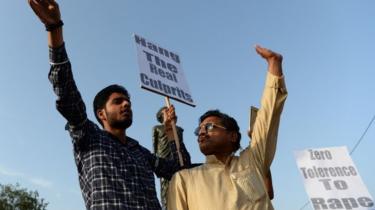
India introduces death penalty for child rapists


India's Cabinet has approved the introduction of the death penalty for child rapists, amid uproar over a series of high-profile cases.

The change to the country's penal code applies to those convicted of raping a child under the age of 12.

There have been nationwide protests in recent weeks over the gang rape and murder of an eight-year-old girl.

The government has come under fire for not doing enough to prevent sexual-assault cases, many involving children.

A number of serious crimes in India carry the death penalty, but raping a child was not among them until now.

Nearly 19,000 cases were registered in India in 2016 - more than 50 each day.

What's in the new law?

The executive order was cleared at a special cabinet meeting chaired by Prime Minister Narendra Modi.

It allows capital punishment for anyone convicted of raping children under the age of 12.

Minimum prison sentences for rape against girls under the age of 16 and women have also been raised.

According to Reuters, which has seen a copy of the order, there was no mention of boys or men.

Why now?

Two recent rape cases have shocked the nation.

Protests erupted earlier this month after police released horrific details of the rape of an eight-year-old Muslim girl by Hindu men in Kathua, in Indian-administered Kashmir in January.

Anger has also been mounting after a member of the governing Bharatiya Janata Party (BJP) was accused last week over the rape of a 16-year-old girl in northern Uttar Pradesh state.

India's poor record of dealing with sexual violence came to the fore after the 2012 gang rape and murder of a student on a Delhi bus. This led to huge protests and changes to the country's rape laws.

But sexual attacks against women and children have since continued to be reported across the country.

How is the death penalty used in India?

Executions are rarely carried out in India, with just three recorded in the last decade.

The four men convicted in the Delhi bus case were sentenced to death, though this has not yet been carried out.

The judge in that case said it fell into "the rarest of rare category" which justifies capital punishment in India. India's penal code, according to the Hindustan Times, had already prescribed the death penalty for gang rape.

Hanging is the main method of execution. 

Barbara Bush's funeral draws more than 1,000 mourners to honor her life


More than 1,000 mourners gathered in Texas on Saturday to pay their respects and celebrate the life of Barbara Bush, the matriarch of a Republican political dynasty.

Bush, only the second woman in US history to have had a husband and son elected President, died Tuesday at the age of 92 at her home in Houston. She had been battling chronic obstructive pulmonary disease and congestive heart failure, and decided against seeking additional medical help earlier this week after a series of hospitalizations.

Her son, former Florida Gov. Jeb Bush, grew emotional as he delivered remarks about his mother's legacy. During his last visit with her, Bush said that he asked his mother what her feelings were about death.

"'Jeb, I believe in Jesus and he is my savior,'" she told him. "'I don't want to leave your dad, but I know I'll be in a beautiful place."'

According to Mrs. Bush's wishes, the ceremony at the Bushes' family church, St. Martin's Episcopal Church in Houston, was a very simple service. Her friend, Susan Baker, and presidential historian Jon Meacham also delivered eulogies.

Avicii struggled with fame and had stepped away from the limelight


Avicii dead at 28 01:08

Swedish superstar DJ Avicii made millions dance with his catchy hits, flashing lights and soulful collaborations.

But despite a life of jam-packed arenas and screaming fans, he constantly struggled with fame and health issues. So much so, two years before he died, he took a break from touring and the exhausting lifestyle that comes with it.

In messages posted on social media, Avicii, whose real name is Tim Bergling, said stress, anxiety and illness were a factor in his decision.

Avicii was one of the most successful touring DJs in the industry, working with artists such as Madonna and Chris Martin. He had a crossover pop hit in 2013 with "Wake Me Up," and was a big name in the electronic dance music genre known as EDM.

Last live show

In August 2016, he said goodbye to his fans in what he described as his last live show. The decision to retire from touring was tough, he said, but he needed to step away and pursue other interests.

"Creating music is what makes me happy and I have gotten to know so many great people in my days of touring, seen so many amazing places and created endless of good memories," he posted on social media at the time.

"The decision I made might seem odd to some but everyone is different and for me this was the right one."

Partying and anxiety

Avicii said his more than 800 shows had taken a toll on him, added to his anxiety and drawn him to a life of partying. He also had several health scares, including acute pancreatitis, which he blamed on excessive drinking.

"Yeah I was drinking way too much, partying in general way too much," he said. "Then I got a pancreatitis attack [at 21], which is very rare. So that forced me to do a 180 and stop drinking."

Fans left him supportive messages on Facebook after he stopped touring, with some expressing regret that they did not get a chance to see him live.

He reassured them that he'll continue making music -- in the studio.

And in August 2017, a year after his last tour date, he announced that he was releasing a new album.

"Really excited to be back with music once again, it has been a long time since I released anything," he posted on social media.

"My focus on this first EP of the album was to get a mix of new and old songs, some that fans have been asking about/waiting for mixed with brand new songs that they haven't heard before."

'Avicii: True Stories'

The DJ had been open about his struggles. A documentary about his life, "Avicii: True Stories," highlighted some of his struggles with fame after his 2011 hit song, "Levels," followed by "Wake Me Up" two years later.

"The year of 2015 should have been a peak for the producer, but behind the scenes, it was too much. Stress, anxiety and illness were eating him away," a synopsis of the documentary posted on his site says.

Filmmaker Levan Tsikurishvili describes the documentary as a "cautionary tale that explores the taxing nature and intensity of fame" from the artist's perspective.

"Everybody knows Avicii but very few people know Tim," Tsikurishvili said. " I think this documentary really shows Tim's struggle and strength of character. Being a worldwide superstar artist is not as easy as it looks on Instagram."

Avicii, 28, was found dead Friday in Muscat, Oman. The cause of death has not been released.

Fans and musicians mourn

Heartfelt tributes poured in from fellow musicians and fans alike.

"Devastating news about Avicii, a beautiful soul, passionate and extremely talented with so much more to do," fellow superstar DJ Calvin Harris tweeted. "My heart goes out to his family. God bless you Tim."

Singer Wyclef Jean described him as "a little brother."

"In my darkest hour, I went to Sweden and he was there for me and we found light in great conversation and in music," Jean tweeted. " He will be forever be missed. This pain I cannot describe."

Monday, 9 April 2018

My second term bid based on clamour by Nigerians, Buhari says


President Muhammadu Buhari on Monday said his decision to seek re-election in 2019 was based on the clamour by Nigerians.

According to a statement by his Senior Special Assistant on Media and Publicity, Garba Shehu, the President said this at a closed-door meeting of the National Executive Council of the ruling All Progressives Congress, held at the party’s headquarters in Abuja.

The statement read, “President Muhammadu Monday in Abuja declared his intention to seek re-election in 2019.

“President Buhari made the declaration at a closed-door meeting of the National Executive Council of the All Progressives Congress.

“The President said he was responding to the clamour by Nigerians to re-contest in 2019, adding that he wanted to give NEC the honour of notifying them first.

“Shortly before making the declaration, the President presented a speech on the report submitted by the APC National Executive Technical Committee.”

According to the News Agency of Nigeria, Buhari had earlier presented a speech on the report submitted by the APC National Executive Technical Committee, and specifically thanked members of the committee for carrying out its assignment on time.

“It shows a great sense of commitment to the ideals of our party with a view to consolidating and positioning the party to continue delivering good governance in the overall interest of Nigerians.

“With the present state of the party and based on the report submitted by the Technical Committee, it is important to focus on how to move the party forward by avoiding actions detrimental to the interest of the party.

“Considering that politics is a game of numbers, we must not be a house divided against itself and must try to note, appreciate and accommodate our differences as far as the law permits.

Buhari declares to run for second term


“President Muhammadu Buhari has just officially announced his intention to seek re-election in 2019.”

This was the simple statement released by the President’s Personal Assistant on New Media Engagement, Bashir Ahmad.

Our correspondent also reported that Buhari made the declaration on Monday morning (today) at the ongoing National Executive Committee meeting of the ruling All Progressives Congress.

The President has asked party members to grant waiver to the party’s National Chairman, John Odigie-Oyegun, and other members of the National Working Committee who want to seek re-election.

NEC meeting, which is presently holding, is being attended by Vice President Yemi Osinbajo, Senate President Bukola Saraki, Speaker of the House of Representatives Yakubu Dogara and 24 state governors.

Before now, 75-year-old President Buhari had left Nigerians guessing as to whether or not he would run for second term.

As of March 1, the All Progressives Congress had passed a vote of confidence in President Muhammadu Buhari, denying that it was not the same as endorsing the President for a second term.

By April 1, while preparations had started among politicians for the elections, all eyes had remained on Buhari who had, until now, remained silent on whether or not he will seek re-election.

His loyalists, APC governors, as well as the chieftains of the ruling All Progressives Congress all expressed their support for him to go for a second term.

See the tweet announcing his intention to seek re-election in 2019:


We’ll release another looters’ list soon – FG


The Minister of Information and Culture, Alhaji Lai Mohammed, on Sunday said the Federal Government would ‘very soon’ release another list of looters.

He stated that no intimidation from any quarter would debar the Federal Government from releasing the list.

He spoke with journalists in Ilorin, the Kwara State capital.

Mohammed said,  “We are not going to ask anybody not to go to court, but what we are telling them is that they should re-examine themselves because when the government came out with its list, it was confident of the evidence it had.

“No government worth its salt would be challenged and would not come out to prove that what it is saying is correct.

“When it comes to evidence it’s for the courts to decide, but we want to make it clear that no amount of intimidation from any side would prevent the Federal Government from releasing the next batch of looters’ list and what you have seen so far is the tip of the iceberg. You will see that many people that Nigerians did not suspect partook in the national looting.”

“Interestingly, we have people saying that they are going to court, you see courts are for the accused person and the accuser, courts are for the rich and the poor, courts are for the government and the governed. So, anybody that says that he’s going to court, that shouldn’t frighten anybody.”

Gay men fight in Lagos after contracting HIV


There was chaos in Egbe, in the Ikotun area of Lagos State, when some homosexuals allegedly fought one another after contracting the Human Immunodefeciency Virus.

PUNCH Metro gathered that one of the men, identified as Ezeugo, infected his first lover with the virus.

Ezeugo had reportedly brought in another boyfriend to the house and was about to make love to him when the first boyfriend raised the alarm around 3am on Tuesday.

Our correspondent learnt that policemen from the Ikotun division were invited by residents and the suspects were arrested.

A police source said the prime suspect, Ezeugo, confessed to have been a homosexual for about five years.

He said, “We got a distress call from residents around 3am that there was a fight among five homosexuals living together in a room apartment.

“On getting there, we were told that late that night, the neighbours heard a noise and thought a thief had broken into the house.  But they later discovered that the noise came from the room where the men stayed and that they were fighting.

“The tenant who accommodated the others, Ezeugo, had gone out to bring a new gay partner and was about to sleep with him when his first lover protested that he could not be sleeping with him and his tribesman from Calabar, Cross River State.

“Ezeugo denied that he wanted to sleep with the new person.

“While we were interviewing them, the first lover said his major grouse was that Ezeugo was sleeping with him and wanted to sleep with his tribesman as well.”

But the state Police Public Relations Officer, SP Chike Oti, said the suspects fought after they discovered that they had been infected with HIV.

Oti identified the men, whose ages ranged from 20 to 31, as Ezeugo, Akachukwu, Abuchi, Dara and Marvellous.

The police spokesperson said the five suspects were in custody and they were assisting with investigation.

He said, “They were into gay relationship and a quarrel broke out among them. The security men who listened to their heated argument alerted the police and the Ikotun Divisional Police Officer sent men there to arrest them. One of them confessed to be HIV/AIDS positive and said it was his boyfriend that infected him. The boyfriend was sleeping with the other men as well and that was the cause of their fight.”

Do policemen have right to search people’s phones, laptops?


The police have the responsibility to conduct ‘stop and search’ on any property or a personal belonging that they have reasonable suspicions that it is a subject of crime. If it is not a subject of crime, they can’t hold on to the object but the law permits the police to go to any length in their investigations or go anywhere and ask questions. If a crime is committed in Abuja or anywhere, they have the responsibility to check any property either randomly or frequently or otherwise. When you are holding a laptop and the police have reasonable suspicions that it was stolen, they have the right to check. Peoples’ vehicles are broken into and laptops are stolen; personal and corporate data are also stolen. So, how do you recover them without checking the laptops? People also burgle houses and personal possessions are carted away, so the police have the right to check and recover them if they are suspected to have been stolen.

The police can also search laptop shops where many stolen laptops and phones are often sold and through searches, the police could recover many stolen property. If a policeman demands to see your laptop, you should first ask for his identity to determine if he is a police officer because if you are in mufti and you demand to search my bag, I would need to know if you are a police officer. Secondly, you should ask the policeman why he wants to search your bag or laptop; he must tell you whether he has a complaint of stolen goods or laptop or whether a crime has been committed. But if you are in your house, the police must present a search warrant before searching your house.

ACP Jimoh Moshood (Force Public Relations Officer, Abuja)

They have no right to check people’s phones on the roads, streets or in their cars. People have a right to self dignity, which is a fundamental human right. Prying into people’s privacy — part of which is checking their phones and laptops — is tantamount to violating their rights to self dignity.  The police frown seriously on that.

In the event that a policeman checks your phone on the road, you have the right to report that policeman for disciplinary action to be taken. The person can also resist releasing the phone. He can also ask the policeman if there is any report against him that he uses his phone for crime. If the policeman says yes, the person should ask the policeman to take him to the police station to see if indeed there is any entry or petition made against him.

If a policeman cannot provide answers, then he has no right to look at your phone. By the time you ask these questions, the officer will know you are well informed. However, where there is a criminal allegation that borders on cybercrime against a person, the police have right to request to look at your gadgets suspected to be tools of the crime.

SP Chike Oti (Police Public Relations Officer, Lagos State Police Command)

The police have the authority to scrutinise the laptops of those they suspect to be criminals. The police do not just stop motorists and ask for their laptops. Something must lead to their being curious about a particular person or persons on the roads. You should also know that modern policing is intelligence-based. There are many suspected armed robbers, kidnappers or cult suspects that have been apprehended through routine checks. And if they have a cause to demand information from you if you are not criminally-minded, you have the right to furnish them with the required details they ask you. The police are human; they are not there to harm you but to protect you. Remember the work of any policeman is to safeguard our environment. If you do not help them, there is little or nothing they can do to provide the needed security for the safety of lives and property of Nigerians. If the laptop is suspected to be a stolen one or contains incriminating information or is being used for criminal purpose, yes they can search it or else it’s uncalled for. However, paucity of information is what always makes the job of policing difficult. If the citizens cooperate effectively with the police by volunteering necessary information about criminals, the country would be a better place for everybody to live and do business. I advise those travelling with laptops to hold their receipts. It will prevent unnecessary search, delay and embarrassment. The police are not to make such searches all the time except when very necessary.

DSP Odiko Ogbeche (PPRO, Akwa Ibom State Police Command)

No police officer, either on patrol or guard duties, has the right to go through people’s phones and laptops, except there is a specific case reported concerning such items that are under investigation. Laptops and telephones are personal and private items of their owners which may contain data and information which is personal to them, and should be treated as such. Members of the public confronted with such situations must insist on not releasing them for search but rather request to be taken to a police station where senior officers’ attention will be required.

Complaints of rights abuse by policemen, especially the junior cadre, have been on the rise before the authorities came hard on them and decided to put a stop to such illegal acts, especially on the issue of telephone search for extortion purposes by labelling the bearers of such gadgets as ‘Yahoo’ boys or girls, (because it does not exclude ladies). It was rampant,  hence the release of a statement by the Kwara State Police Command alerting members of the public to their rights to resist being exploited by any police officer.

Telephone numbers were published which they could call to report such infraction. Searching of people’s phones or laptops is an offence for which any errant police officer could be punished. The image of the police is seriously challenged by such unprofessional attitude which the police authorities are doing everything possible to eradicate, and as such little distractions like checking of telephones for the purpose of extortion cannot be accepted. Members of the public are admonished to  be ready at all times to join hands with the police authorities to discourage  some of the personnel who are still in the habit of perpetrating these embarrassing acts. Policemen are trained and are duty-bound to be civil in all their dealings with members of the public. Only in a situation of investigation involving telephone or a laptop is a policeman entitled to search a citizen’s telephone.

DSP Ajayi Okasanmi (PPRO, Kwara State Police Command)

It has been said time without number that people’s laptops and phones are their personal properties which cannot be subjected to any form of search without the proper search warrant. People have a right to their privacy which must not be intruded into by anybody. But it must be noted that for every rule there must be an exception. It is also important to note that fundamental human rights are not absolute; there may be an occasion where such a search can be conducted urgently in order not to jeopardise investigation into a serious case.

If there is a report of a serious crime which involves the use of devices like laptops, phones or any other ICT equipment and a suspect or suspects are rounded up in such an environment, any of such devices found in their possession can be searched on the spot so as not to give them the opportunity of destroying the evidence which may eventually jeopardise the investigation and apprehension of the culprit. Also, in a case of fraud, where it is discovered that a suspect used his laptop or any other ICT equipment to siphon money from another person’s account, if such a suspect is arrested, the laptop found with him can be searched on the spot regardless of where the person was arrested.

In these types of situations, it will be difficult for the police to get a duly signed search warrant on the spot and the search is highly necessary. Aside from situations like the ones mentioned above, nobody has the right to accost anybody on the road and start violating his or her privacy.

INTIMATE PARTNER VIOLENCE: THE ABUSERS AND THE KIND OF VICTIMS THEY SEEK.

The problem with domestic violence is real. Gender socialization continues to play a major role in this matter. Men are trained to be st...